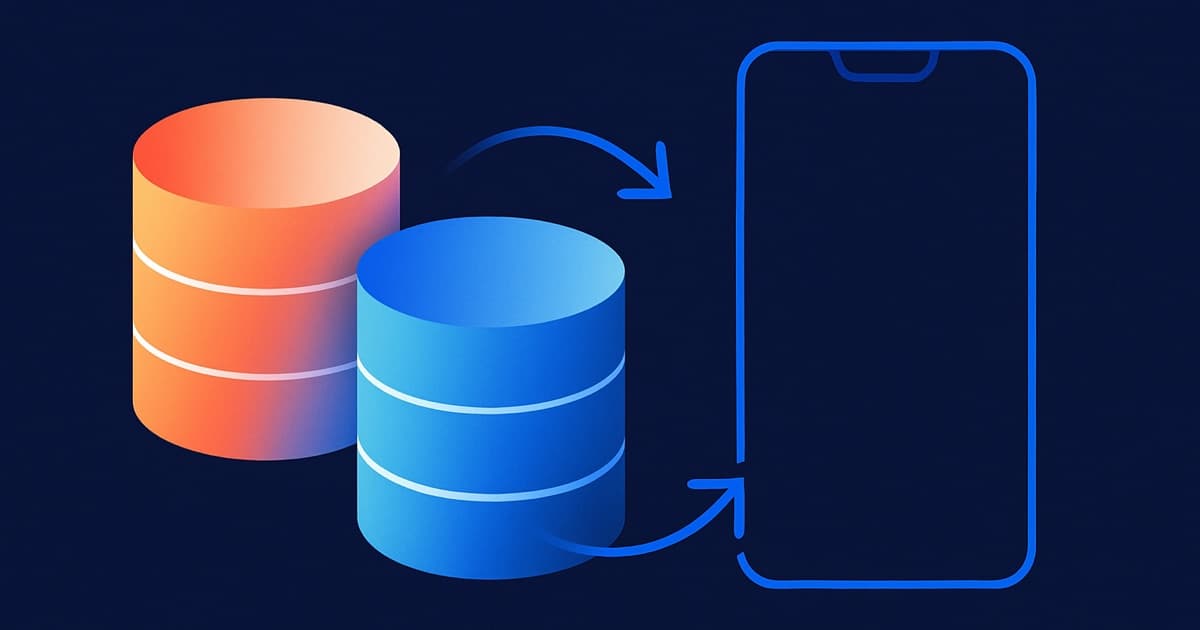
For a mobile MVP, Firebase wins when you need offline persistence, push, crash reporting and auth in one SDK and your data fits a document model. Supabase wins when your data is relational, you want SQL, joins and row-level security, or you want to avoid vendor lock-in. Firebase's free tier is pay-as-you-go; Supabase's is capped and pauses after a week idle, with Pro at $25 per month.
We have shipped Flutter apps on both. Dazzl, SlimAI and Spyra Beauty run on Firebase. Cru Social runs on Supabase and Postgres. This article describes what we saw, not a benchmark. Where we quote pricing or limits, the figures come from the vendors' pricing pages as of 30 September 2026 and will change.
Firebase vs Supabase: comparison table
| Criterion | Firebase | Supabase | Our take |
|---|---|---|---|
| Data model | Firestore: document collections, no joins, denormalise for reads, composite indexes for compound queries | Postgres: tables, foreign keys, joins, views, full SQL | Supabase for relational data; Firebase for feed-shaped or per-user data |
| Auth | Firebase Auth: email, phone, Google, Apple and more; anonymous accounts; tightly integrated with security rules | Supabase Auth on GoTrue: email, magic link, OAuth providers, phone; JWT used directly in row-level security | Even; both cover MVP needs |
| Realtime | Firestore snapshot listeners on documents and queries, built into the SDK | Realtime channels for Postgres changes, broadcast and presence; subscribe per table or filter | Firebase is simpler; Supabase is more flexible |
| Offline | Firestore offline persistence built in on iOS and Android; writes queue and sync | No first-party offline cache in the Flutter SDK; you add a local store and sync layer | Firebase, clearly |
| Pricing model | Spark plan free; Blaze pay-as-you-go per read, write, GB and function call; Firestore free quota of 50K reads and 20K writes per day | Free plan capped at 500 MB database and 50K MAU, pauses after 7 idle days; Pro $25/month per project with 8 GB database and 100K MAU plus overages | Firebase cheaper at tiny scale; Supabase more predictable once live |
| Vendor lock-in | Proprietary APIs and security rules; export is possible but a migration is a rewrite of the data layer | Standard Postgres; dump and restore to any host; open-source stack can be self-hosted | Supabase |
| Local dev | Firebase Emulator Suite runs Auth, Firestore, Functions and Storage locally | Supabase CLI runs the full stack in Docker with migrations and seed data | Even; Supabase migrations are easier to version |
| Flutter SDK maturity | FlutterFire is first-party, covers Analytics, Crashlytics, Messaging, Remote Config, App Check and AI | supabase_flutter is first-party and stable; fewer adjacent services, so push and crash reporting come from elsewhere | Firebase, for breadth |
What Firebase gave us on Dazzl, SlimAI and Spyra
Dazzl is a gamified wellbeing app for students with mood check-ins, tasks, focus sessions, quests, a gem economy and a customisable fortress room. Almost all of that data is per user: one student's moods, one student's gems. Firestore's document model fits that shape well. Each user's data lives under their own document tree, security rules are a few lines, and there is no query that needs a join. Offline persistence meant a student on a train could log a mood and complete a task with no signal, and it synced later without any code on our side.
SlimAI, our AI calorie tracker, leans on the breadth of FlutterFire. It uses Firestore for meal logs, Auth, Storage for food photos, Messaging for reminders, Crashlytics for stability, and the firebase_ai package to call Gemini for food recognition. Having one SDK family for all of those cut integration time. It also meant one billing account and one console for a small team. SlimAI has been live since October 2025 with 10,000+ installs and 4.6 stars on Google Play.
Spyra Beauty, a social beauty app with 50,000+ installs, showed the other side. A social feed with likes, comments, follows and product tags is relational data. On Firestore we denormalised it: counters on posts, duplicated author names, fan-out writes on follow. It works and it scales, but every new feature that touches two collections needs a Cloud Function or a client-side merge, and every compound query needs a composite index created in advance. We knew this going in and accepted it for the speed of the rest of the stack.
What Supabase gave us on Cru Social
Cru Social is an aviation social network with a digital logbook. Pilots log flights with aircraft, routes, durations and crew, and the app has to answer questions such as total hours by aircraft type, or night hours in the last 90 days. That is SQL. On Postgres these are views and aggregate queries; on Firestore they would be maintained counters or scheduled functions. Row-level security policies gave us per-user and per-crew access control in the database itself, which the Flutter client cannot bypass.
A Techparser engineer was embedded in the client's team from August 2025 to January 2026 with all work going through the client's code review. Supabase's CLI made that easier: schema changes were migration files in the repository, reviewed like any other code, and applied to local Docker, staging and production in order. The app holds a 4.8-star App Store rating.
The cost was offline behaviour. The Flutter SDK has no built-in offline cache, so anything that needed to work without a connection needed a local store and a sync strategy that we owned. For a logbook that pilots often fill in on the ground with signal, that was manageable. For a note-taking or field-service app it would have been a significant piece of the MVP.
Pricing: how the two models feel at MVP scale
Firebase's Spark plan is free with fixed quotas. Blaze is pay-as-you-go with the same free quotas applied first; Firestore Standard edition charges $0.03 per 100,000 reads and $0.09 per 100,000 writes beyond the free 50,000 reads and 20,000 writes per day, according to Google's pricing pages. An MVP with a few hundred daily users often pays close to nothing. The risk is a listener or a loop that reads a large collection on every screen open; that appears as a surprise on the invoice, not as a build failure.
Supabase's free plan gives 500 MB of database, 1 GB of file storage, 50,000 monthly active users and two active projects, and pauses a project after one week of inactivity. That pause has caught many teams during a quiet beta. The Pro plan is $25 per month per project with 8 GB of database, 100 GB of storage, 100,000 MAU and daily backups, plus metered overages. For a live MVP we treat $25 per month as the floor and like knowing it.
Lock-in and the exit question
Leaving Firebase means rewriting the data layer, because Firestore queries, security rules and listeners have no direct equivalent elsewhere. Leaving Supabase means a Postgres dump and restore plus swapping the auth and storage clients; the schema, policies and SQL travel with you. This matters less than founders think in month one and more than they think in year two. If an acquirer, an enterprise customer or a data-residency rule could force a move, weight this row heavily.
How we choose for a new MVP
- Draw the data. If most entities belong to a single user and are read together, Firestore is a fit. If entities reference each other and you will report across them, use Postgres.
- List the offline requirement honestly. Must-work-offline points to Firebase unless you have time to build sync.
- Count the adjacent services. If you want push, crash reporting, remote config and analytics from one console with one SDK, Firebase saves weeks.
- Ask about the exit. Regulated data, enterprise buyers or a likely self-hosting requirement point to Supabase.
- Check the team. Engineers who think in SQL ship faster on Supabase; engineers who have built on Firestore before know where its edges are.
We do not have a house default. Three of our four most recent Flutter apps are on Firebase because they were per-user products that needed offline support and the broad FlutterFire toolset. The fourth is on Supabase because its core feature is a report over relational records. Our MVP development service starts with this decision because it is the one that is expensive to reverse.
Frequently asked questions
- Is Supabase better than Firebase for a mobile app?
- It depends on the data. Supabase is better when your app is relational, needs SQL joins and reporting, or must avoid vendor lock-in. Firebase is better when data is per user, offline support is essential, and you want auth, push, crash reporting and analytics from one SDK. Both have first-party Flutter SDKs and both run production apps at scale.
- Does Supabase work offline in Flutter?
- Not out of the box. The supabase_flutter SDK has no built-in offline cache or write queue comparable to Firestore's offline persistence. To support offline use you add a local database and a sync layer of your own or from a third party. For apps that mostly run with connectivity, such as our Cru Social logbook, this is manageable; for field apps it is real work.
- How much does Firebase cost for an MVP?
- Often near zero. The Spark plan is free, and on Blaze, Firestore still gives 50,000 reads and 20,000 writes per day free, then charges about $0.03 per 100,000 reads and $0.09 per 100,000 writes on the Standard edition, per Google's pricing pages in September 2026. Costs rise with inefficient listeners and functions, so set budget alerts before launch.
- How much does Supabase cost for an MVP?
- The free plan covers 500 MB of database, 50,000 monthly active users and two projects, but pauses after seven idle days. The Pro plan is $25 per month per project with 8 GB of database, 100 GB of storage, 100,000 MAU and daily backups, plus metered overages, according to supabase.com in September 2026. Most live MVPs should budget for Pro.
- Can you switch from Firebase to Supabase later?
- Yes, but it is a data-layer rewrite rather than a migration. Firestore documents must be mapped to tables, security rules re-expressed as row-level security policies, and every query and listener rewritten in SQL or the Supabase client. Auth users can be exported and imported. Plan for weeks, not days, and do it before the product has many integrations.
About the author
Zoraiz Ejaz
Co-founder, Techparser
Zoraiz Ejaz is a co-founder of Techparser and leads its engineering and product practice. He has spent close to a decade designing, building and scaling mobile, web and AI products for startups and enterprise teams across health, fintech, payments, social and education, from first architecture and release pipelines through to launch and years of production support. He writes about how to scope, cost and ship software that lasts.