Fintech
How Xendit's Merchant App Shipped Payment Links, QR and Card Payments in Two Markets
Techparser embedded a senior engineer in Xendit's merchant payments app team from 2021 to 2023: 329 commits across payment links, QRIS and card payments.
- Client
- Xendit
- Industry
- Fintech
- Timeline
- November 2021 – October 2023
- Team
- 1 senior engineer embedded in Xendit's mobile team
Results
- 2 years
- On the team, November 2021 to October 2023
- 329
- Commits to the merchant app codebase
- 2
- Markets served: Indonesia and the Philippines
The problem
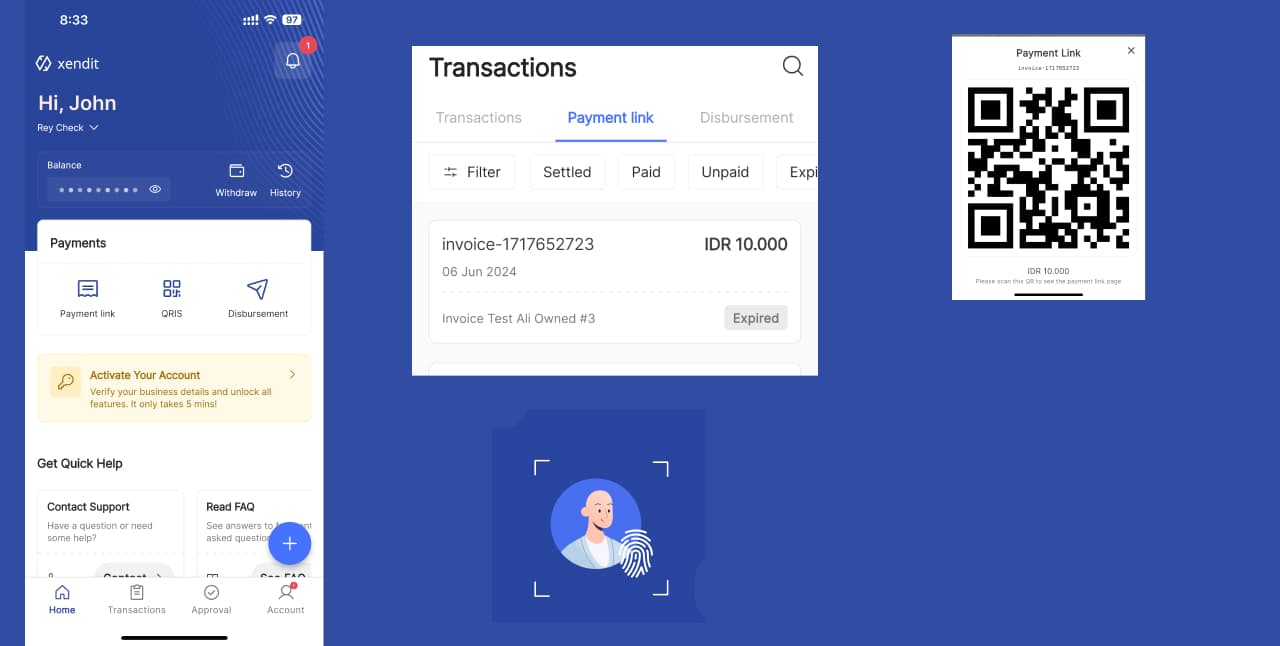
Xendit's merchant app lets businesses in Indonesia and the Philippines get paid: payment links they can send over chat, QR codes customers scan at the counter, card payments in person, and disbursements and withdrawals of the balance. The app already had a team and a large codebase when Techparser joined in November 2021. The problem was scale of delivery: many engineers, two markets with different payment rails, and a release cadence that had to keep pace with the product roadmap without breaking money movement. Payment links, QRIS and card payments each settle differently, and merchants expect the resulting balance, history and withdrawals to update in one place.
Features in a payments app are not shippable from a design alone. Each needs a technical specification that covers API contracts, error states, PIN and biometric gates, and what happens when a network call fails halfway through a payment. The team needed someone who could write those specs, break them into tickets, assign them across engineers, and see the resulting builds through to both stores.
What Techparser built
- Payment links: create, share and track links so a merchant can be paid over chat or social media without a storefront.
- QRIS payments: Indonesia's national QR standard, so a customer scans and pays at the counter.
- In-person card payments, with card type detection and a card scanner.
- Disbursements, withdrawals, balance history and a transactions list.
- Account security: PIN creation and checks, OTP verification, a biometric prompt, forgot-PIN flows and jailbreak detection at launch.
- Merchant onboarding and growth: sign-up, email verification, instant activation, a personal referral code and in-app campaigns.
- Technical specifications for new features, ticket breakdown and assignment, and build delivery to the stores.
- Analytics and growth tooling: Firebase Analytics, Crashlytics, Performance and Remote Config, CleverTap, Branch deep links and Snowplow events.
Decisions that mattered
Specs before tickets
Payments features have more failure paths than happy paths. Techparser's engineer wrote the technical specification for each feature before it was split into tickets: the API calls, the states a screen can be in, the PIN and biometric checks that gate an action, and the behaviour when a request times out. Tickets were then cut from the spec and assigned across the team, so several engineers could work on one feature without colliding or reinventing the error handling.
Owning delivery, not just code
Beyond writing features, the role covered managing build delivery: preparing releases, tracking what was in each build, and getting it through review on both stores for two markets. Over 329 commits between November 2021 and October 2023, the codebase reached version 3.7.7, and the engineer was one of the top contributors by commit count on a team of more than a dozen developers.
Work inside the team's conventions
The app follows a generated module structure, with data, domain and module layers and a spreadsheet-based translation pipeline. Techparser's contributions followed those conventions so that code written by an embedded engineer was indistinguishable from the team's own, which is the standard Techparser holds for any staff-augmentation engagement: the client's architecture, the client's review process, the client's release cadence.
A gate on every money movement
A merchant app holds a balance, so every action that moves money sits behind a check: a PIN that is created at onboarding and confirmed before withdrawals and disbursements, a one-time code for sensitive changes, a biometric prompt as the fast path, and secure on-device storage for tokens. The landing flow also detects jailbroken or rooted devices before the merchant reaches their balance. These gates were specified once and reused across features so that a new payment type did not mean a new security design.
Outcome
Techparser's engineer worked on the Xendit merchant payments app from November 2021 to October 2023, contributing 329 commits to a codebase that reached version 3.7.7 during the engagement, alongside a team serving merchants in Indonesia and the Philippines.
The features shipped in that period include payment links, QRIS, in-person card payments, disbursements and account security flows. In the same period the engineer also worked on Xendit's Apollo app, an employee reimbursement tool with submission, approval flows and payouts. As of September 2026 this study reports no store figures, because the apps are published by Xendit rather than Techparser. The record of the engagement is the commit history and the features that shipped.
Questions about this project
- What did Techparser do on the Xendit merchant payments app?
- A senior Techparser engineer worked inside Xendit's mobile team for two years, from November 2021 to October 2023. The role covered writing technical specifications, breaking them into tickets and assigning them, building features such as payment links, QRIS and card payments, and managing build delivery to the stores. It was an embedded engagement in the client's codebase.
- What stack does the merchant app use?
- Flutter with a scaffolded modular structure, Dio for networking and Hive for local storage. Firebase provides Analytics, Crashlytics, Performance, Messaging and Remote Config. Growth and attribution run through CleverTap, Branch and Snowplow, and the app supports biometric login, NFC and card scanning for in-person payments.
- Can Techparser embed a senior engineer in our fintech team?
- Yes. The Xendit engagement is the model: an engineer who joins your team, follows your architecture and review process, writes specs as well as code, and takes responsibility for delivery. Techparser's flexible-teams service covers single engineers through to small squads, on your tools and your timezone overlap. Book a call to discuss the role you need filled.